Recently, I completed my first IRONMAN 70.3. For those who are not familiar with this type of event, it is a long distance triathlon: a 1.9 km swim, a 90 km bike ride, and a 21.1 km run, all done consecutively in the same day. The three distances add up to 70.3 miles, which is where the name comes from.
For nine months, I planned how to structure my training because I decided to do it without the help of a coach. I based most of the plan on the Triathlete’s Training Bible by Joe Friel. It is a very complete book and gives you a clear and relatively simple idea of how to build a training plan.
The original approach was to track the training every day using excel template. However, for me it was missing visualization and automation.
Manually entering every day how much I trained, how I trained, how many calories I consumed, and many other variables was simply too much to monitor consistently.
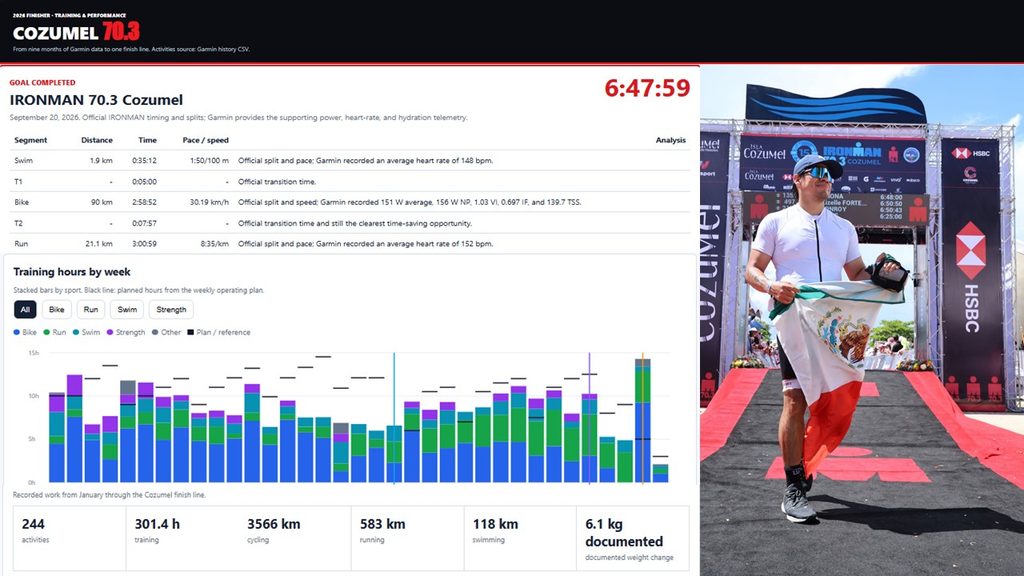
So I built an app with the help of ai. I connected it to the garmin API and started downloading all my activities and the data associated with them every day: speed, pace, watts, distance, time, and other metrics. I stored all this information locally in csv files and, with the help of python, automated a web portal inside my own site, carmonex.com.
For nutrition, I used Fitia. I tracked my diet there and exported the information every week so it could also be incorporated into the dashboard. The result was much more useful than I expected.
I no longer had to worry about updating the numbers every week and comparing them manually against the weekly plan or against each stage of the nine month training cycle. Chatgpt was doing a large part of that work for me and presenting the results in a few charts that allowed me to clearly identify where I was slowing down, where I was falling behind the plan, and in which discipline I needed to put more effort.
The most interesting part came later. Because I had all this information available locally, I could ask AI questions about my own historical data. I could compare periods, review how I had trained before certain sessions, build shorter term strategies, and make corrections along the way using my own data.
Of course, most of this information already exists inside garmin, with the exception of nutrition, garmin also offers premium services with ai based recommendations but building something like this at home, with a relatively small number of hours, was practically free and gave me a tool designed exactly around what I wanted to monitor.
Having trend charts separated by sport and specific numbers for swimming, cycling, and running also helped me understand where I needed to put more effort during each stage of the training.
The objective was achieved. I completed my first IRONMAN 70.3 in 6:48 hours.
But one of the most interesting things I learned from building this app goes beyond the race itself. The gap between a person with an idea and functional software is becoming smaller and smaller. Today, almost anyone can use ai to turn an idea into something functional and highly personalized in a matter of hours.
If you have some technical foundations makes the process much faster, especially when you start working with APIs, data structures, automation, authentication, or deployment. But even with that in mind, I see this becoming increasingly achievable for almost any professional profile and for almost any type of problem. There is also something else that I find especially interesting. This type of software does not necessarily have to become a product or a startup to have value. Sometimes it only needs to solve a very specific problem extremely well for one person.
Leave a Reply